
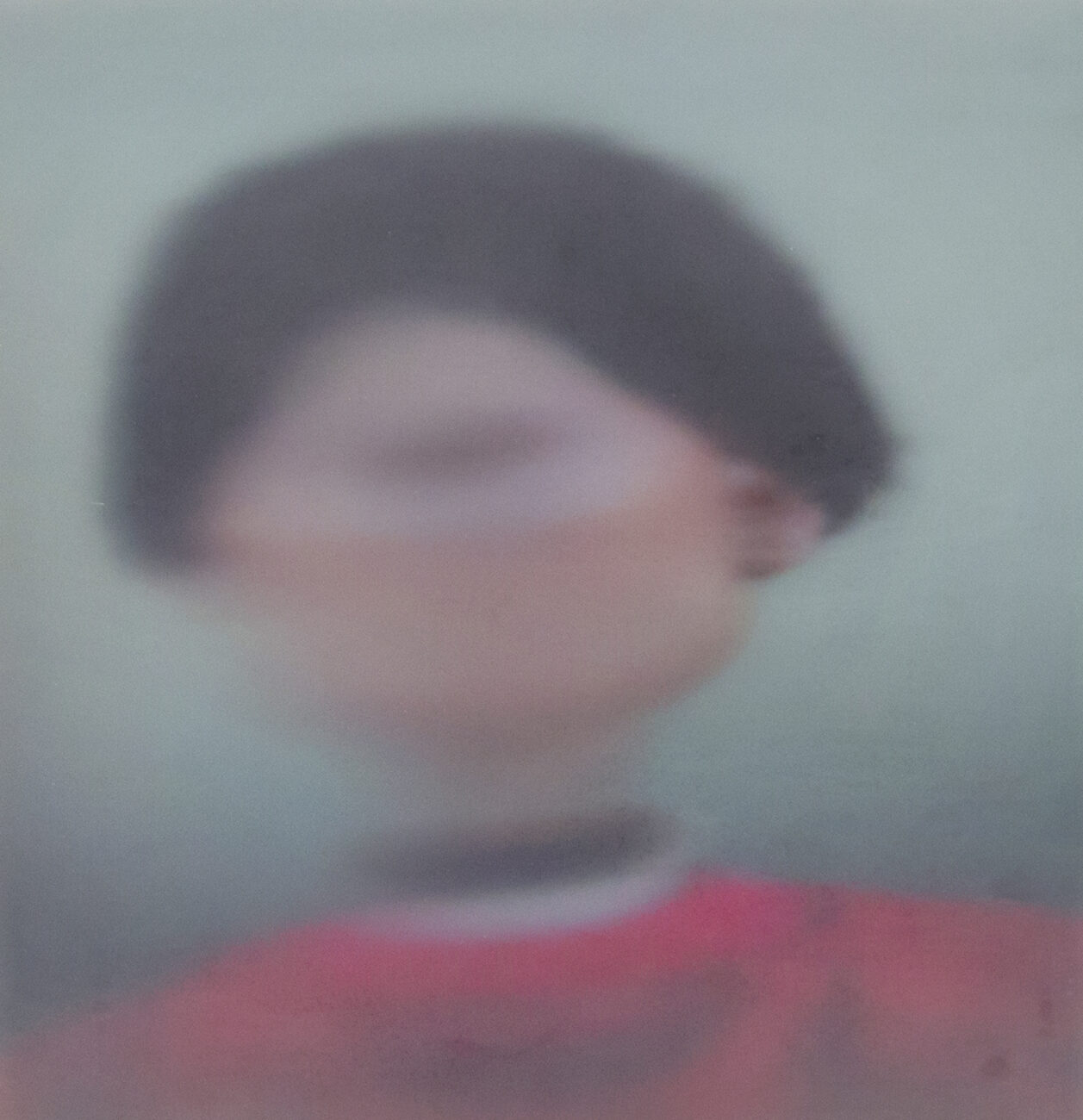
Beeswax is known in the history of Western philosophy as a material through which the relationship between form, matter, and perception has been explored. Its ability to transform while retaining continuity has made it a recurring example in thinking about identity (that is, an object being identical with itself) and change. Elina Vainio’s exhibition Memory Palace at Photographic Gallery Hippolyte examines this idea differently: beeswax forms the surface of a serial work, leaving both what it binds and what it protects subject to change. In this way, it makes visible how the image is always somewhat inadequate to the conditions of human experience.
Vainio’s focus is on a layered and fragmented perceptual experience, a memory composed of breaks and gaps, and a corporeality that attaches itself to words while constantly tearing apart and remaining susceptible to distortion. In Vainio’s work, consciousness does not appear as a clear psychological reality, but rather as a cluster of highly contingent traces. Her experimental practice, in which artistic thinking takes place through the particularity of the method employed and is constrained by the properties of a new material, emphasises the question of the uniqueness of form and matter. In the case of speaking beings, it is this corporeal uniqueness that makes a coherent and unified mode of being, or a lasting anchoring of the self, impossible.
The body of work in the exhibition consists of photographs taken on a phone using reflections in a bent mirror film. The printed photographs are mounted onto steel plates with a thin layer of beeswax. The images are then coated with liquid beeswax which, as it solidifies, permanently binds them to the steel surface. Each individual image is, in turn, immersed in water at approximately sixty degrees Celsius and slowly lifted through the wax, which remains molten at the surface of the water. Through repeated treatments, the beeswax coating creates a form that moves away from the image’s original photographic surface, giving the image a new shape. Optical distortions, material layers, and the gradual loss of definition are set alongside the internal logic of the images: rather than being carried by clear meaning, the viewer is held by the repetition of perceptual and linguistic distortions. In Vainio’s process, deviations in the image do not point to dysfunction but bring into view the absurd aesthetics of human existence.
– Aino-Marjatta Mäki, psychoanalyst
Elina Vainio (b. 1981) is a Helsinki-based visual artist whose installations and serial works have been exhibited at venues including Liste Art Fair Basel (2026), Ulterior Gallery, New York (2026), EMMA – Espoo Museum of Modern Art (2025), and the Seoul Museum of Art (2025). She holds a BA in Fine Art from Chelsea College of Art & Design in London and an MFA from the Academy of Fine Arts at the University of the Arts Helsinki. Vainio is the recipient of the 2026 Nordea Art Foundation Art Award.
The exhibition has been supported by the Kone Foundation and the Uusimaa Regional Fund of the Finnish Cultural Foundation.
___________________________________________
Formless
Laura cannot explain what has happened: “I started losing my ability to concentrate and could no longer practise.” Since then, everything has been “formless” and “things just slide over me.” Laura is a young pianist who has played since early childhood. She is returning to her professional studies after a year-long break, but still cannot maintain a regular practice routine: “It’s not at the level it should be. It’s not good enough.”
Formlessness first manifests itself in writing: “I couldn’t grasp words or a complete sentence. Everything just slipped away, it was incoherent.” Laura did well in primary school, quickly memorising what was taught in class. However, she could not manage written homework. In secondary school, the situation changes, as she can no longer keep up with her studies through what she learns in class alone. Gradually, even speaking to others begins to feel to Laura like a threat of real loss: “It’s as if other people were tearing things out of me.” She feels it is better not to have contact with other people than to risk something “going wrong.” This thought, however, creates a new problem in her relationship with music. For her, what is special about music is the “impossibility of playing perfectly.” Yet individual musical expression is impossible for Laura. She would like to play with pure technical precision, minimising the possibility of mistakes, but this entails the loss of musicality. Her teacher continually reminds her of this.
Laura has few memories of her childhood and no stories about her family, nor does she recognise her own image: “It’s not that I dislike it, it just isn’t familiar.” She describes her experience through a tension that runs through her: “It is unbearable to be in this body as it is, and it is unbearable to change it.” Laura knows that her difficulties are unlikely to change significantly. The same applies to her piano playing. I position myself accordingly: without expectations. The same is true of psychoanalysis; she does not expect it to bring about any major changes. The work does, however, allow for a minimal margin of movement: “It’s not necessary to believe in anything, but that doesn’t mean complete disbelief if you keep coming,” she says.
Following one of our conversations, however, Laura develops a new idea: that playing technically and without musicality can itself be a form of expression, if it is unconventional. Gradually, Laura returns to practising. She now focuses her attention on technical problems in the sound: on how her fingers press the keys too hard or too lightly, move across them at the wrong speed, or on slight problems in the positioning of her hands and wrists. Through this “trinity of errors”, she can play “without excessive possibilities.” Now she plays from within her mistakes, bounded by them.
Her ability to play, however, comes and goes. During one particularly difficult period, I ask her to teach me how a pianist positions themselves in relation to the instrument. She guides me precisely: I ask how the body should be positioned at the piano, at what angle the hands should be held, how the back should be curved, and how far apart the feet should be. I follow her instructions, positioning my body accordingly , while naming aloud the parts of the body through which the piano supports the player. When she arrives for the next session, the difficulties of the previous session have disappeared. Her form holds once again, but not without the instrument.
Aino-Marjatta Mäki, psychoanalyst (The New Lacanian School, WAP)
The text is an excerpt from a fictional case study.
Elina Vainio
Memory Palace
11 September – 11 October 2026
Photographic Gallery Hippolyte
image: Elina Vainio, Self-Portrait from the exhibition Memory Palace, 2026.